The points game isn’t broken. It’s just gotten harder, and a lot of that is by design. Banks keep raising annual fees and stacking up credits nobody asked for, programs keep repricing awards, and redemption options that used to be simple now come with asterisks. The people with the biggest megaphones in this hobby mostly aren’t helping you sort it out, either.
I’ve been playing this game for about a decade and a half, and in that time I’ve earned more than 5 million points and miles. Among my peer group, that puts me somewhere in the middle. I know people who’ve earned 25, 30, even 50 million, which makes my number look like a rounding error. I also know plenty of people who’d hear 5 million and assume I need an intervention.
I still play. I just play differently than I did a few years ago, because the rules underneath the game have changed.
What actually changed
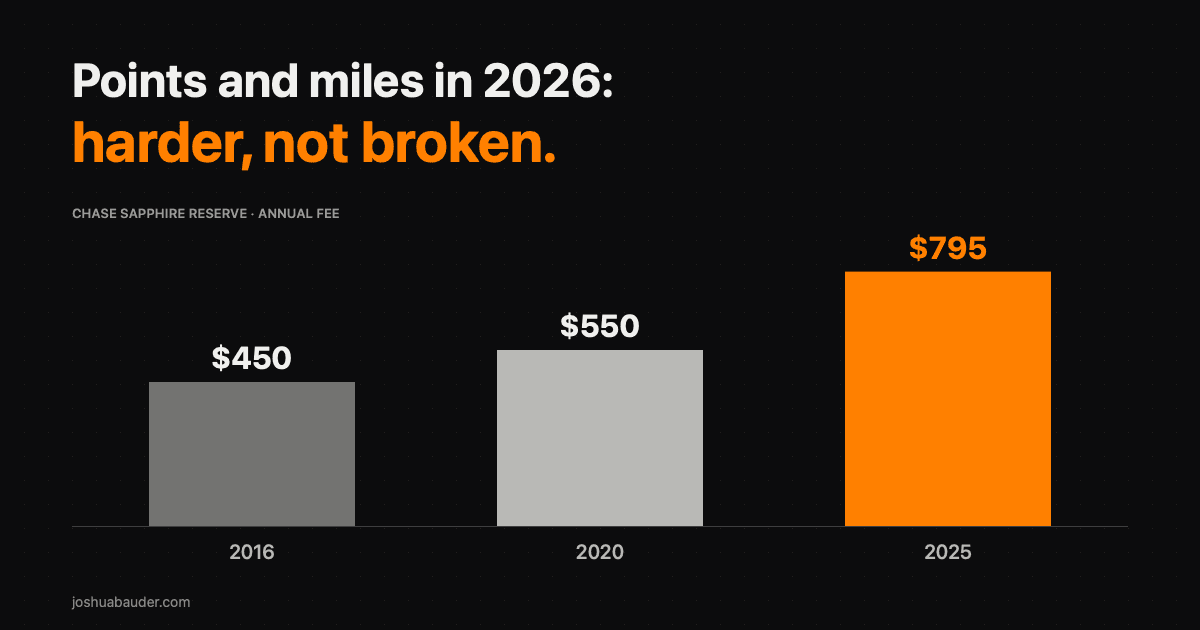
Premium cards turned into coupon books. The Sapphire Reserve is $795 now, and Chase pitches it as more than $2,700 in annual value. The Amex Platinum is $895 with more than $3,500 in credits. Those numbers only mean something if you would have spent that money anyway. Most of the “value” is a pile of credits you have to remember to use, against a fee you’re guaranteed to pay.
Fixed values are disappearing. Chase dropped its flat 1.5 cents per point in the travel portal for rotating “up to” offers. Delta pulled its award chart back in 2015. Virgin Atlantic moved its own flights to dynamic pricing in 2024. When there’s no chart, you can’t tell a good deal from a bad one without checking every time. The banks and programs know most people won’t.
Marriott, where I’m Lifetime Platinum, raised award prices at roughly 95% of its hotels in mid-2026, typically by 5 to 10%. NerdWallet now values Bonvoy points at 0.7 cents, down from 0.8. I’m not a fan of any increase, but I get it to a point. Inflation happened, and costs went up for everyone. A hike across almost the entire portfolio at once still feels like more than keeping up, especially when I’ve seen a Courtyard going for $400 to $500 a night in cash. Marriott prices award nights dynamically, so when cash rates climb like that, the points price climbs right along with them.
The programs that still publish charts keep creeping up. Hyatt went from three award tiers to five in May and raised the top price at some Category 8 hotels from 45,000 to 75,000 points a night. Aeroplan raised a lot of long-haul business class prices on June 1. Charts still devalue. The difference is they warn you first.
None of that means the value is gone. It moved. NerdWallet’s 2026 valuations have American miles up from 1.3 to 1.7 cents and Alaska up from 1.2 to 1.4. Transfer bonuses keep showing up, like Chase’s 40% bonus to Virgin Atlantic in February. The value has shifted away from bank portals and co-branded miles, toward transferable points and partner awards. That’s why I say harder, not broken.
The Sapphire Reserve is the poster child
For me, the biggest devaluation of the last couple of years wasn’t an airline award chart. It was the Chase Sapphire Reserve.
When it launched in August 2016 with a 100,000-point bonus, it set the hobby on fire. The fee went from $450 to $550 in 2020, then to $795 in 2025. Points Boost replaced the flat 1.5 cents with offers worth up to 2 cents on select bookings and 1 cent on everything else. Points you held before the change keep the old rate until October 2027. After that, your points are worth whatever Chase decides to boost that week.
That’s the part that bugs me most. A fixed value was easy to understand. A rotating menu of “up to” offers makes it harder to know what your points are actually worth, and murky math almost never works in your favor.
The Sapphire Lounges are nice. But I fly Delta most of the time, and the Amex Platinum gets me into Centurion Lounges plus Delta Sky Clubs when I’m on Delta. The Platinum isn’t cheap either. It’s $100 more than the Reserve, and Amex capped Sky Club access at 10 visits a year starting in February 2025. It’s still the better card for how I travel, and honestly, I think it always was. So I downgraded the Reserve to the Sapphire Preferred, which keeps my Chase points alive without paying $795 for the privilege.
SkyPesos are still SkyPesos
I fly Delta more than any other airline, and I still think SkyMiles are close to worthless. There’s a reason everyone calls them SkyPesos.
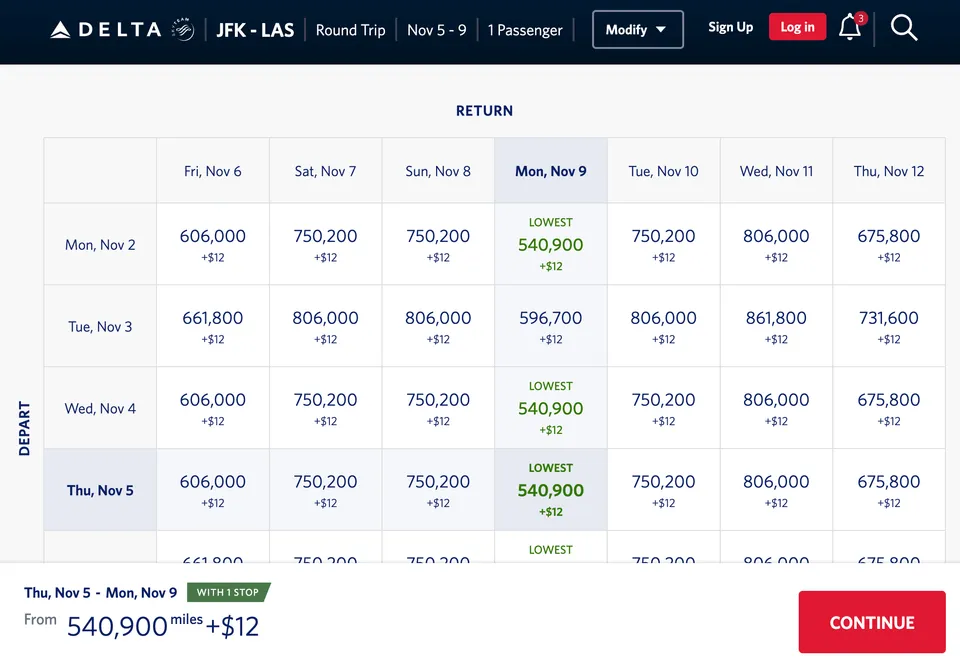
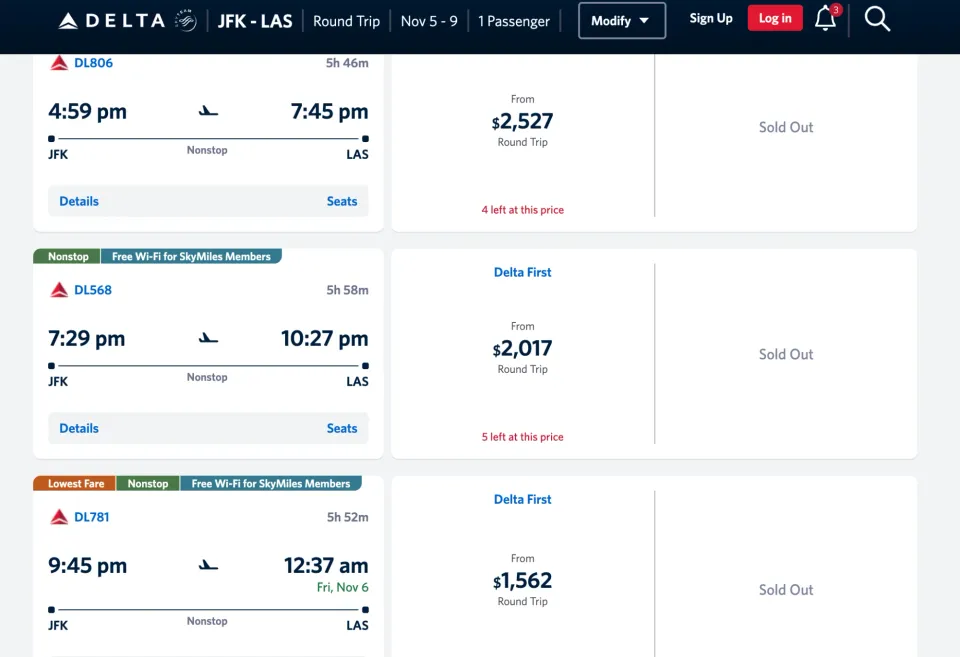
Here’s a real search: JFK to Las Vegas, round trip in first class, for a regular week in November (out November 5, back November 9). The cheapest award on the whole calendar is 540,900 miles and $12, and that’s with a connection. Paying cash, Delta First nonstops on the same dates run from $1,562 to $2,898 round trip.
So Delta wants more than half a million miles for a ticket you can buy for $1,562. That’s under a third of a cent per mile. Valuation sites put SkyMiles around 1.2 cents each, which would make those 540,900 miles “worth” about $6,500. Spending $6,500 worth of anything on a $1,562 ticket is a bad trade, and that’s exactly what Delta is offering.
Holidays don’t change the math. Over New Year’s (December 30 to January 2), the same route costs 812,500 miles with a connection, against Delta First nonstops from $2,337. That’s also about 0.29 cents per mile. Peak or off-peak, Delta prices SkyMiles at roughly a quarter of what valuation sites say they’re worth.
Without an award chart, Delta’s award prices move a lot like cash fares, and here they’ve moved well past them. That kills the outsized deals this hobby was built on.
I’ll keep flying Delta. I just stopped thinking of SkyMiles as something worth earning on purpose.
Be careful who you take advice from
The other thing that made the game harder is that a lot of the advice got bought.
I think The Points Guy is the biggest sellout in this space. TPG is a huge, polished operation, and plenty of its editorial is good. But it’s owned by Red Ventures, a digital marketing company, and it makes its money from credit card affiliate fees. Its own site disclosure says that compensation may affect how and where cards appear. To me, the recommendations have always read like what’s best for their bank account, not what’s best for the reader.
The first tell for me was about ten years ago, when they were pushing the Sapphire Reserve hard while the Amex Platinum was clearly the better card. I can’t completely fault them. Affiliate links are how this whole corner of the internet pays its bills. The problem starts when the payout decides the verdict.
There are still sources I trust. They run affiliate posts too, but they’re honest about it, they give you the good and the bad, and their opinions don’t feel filtered.
- From the Tray Table (yes, Zach Griff came up at TPG, and I still value what he’s doing now)
- One Mile at a Time
- Doctor of Credit
How I play it now
I earn transferable credit card points first, because they’re the currency that held up best and they let me move to whichever program has the best price that day.
I book through partners. My favorite example is using Virgin Atlantic points to fly KLM in business class across the Atlantic, which has priced as low as 48,500 points one way with fees under $300 leaving the US. (Virgin can book Air France too, but I skip it. That’s its own post.)
I search award space myself instead of trusting anyone’s “best card” list, including mine. seats.aero is my go-to for award availability, and the Points Path extension adds award prices right into Google Flights, so I can see the points price and the cash price side by side before I decide which to use.
I don’t hold onto points for long. A balance sitting in an account is exposed to every devaluation and every partner breakup, and you don’t get a vote on either. Aeroplan raised a lot of its award prices on June 1. Amex stopped transferring points to Etihad Guest on June 30. If your plan depended on either one, your points got worse without you doing anything. Points are worth the most when you have a trip to spend them on.
And I treat every annual fee as a decision, not a subscription. If the credits don’t line up with money I’d spend anyway, the card gets downgraded, like the Reserve did.
The game still pays off if you’re willing to do the work yourself. The people getting burned now are the ones outsourcing their decisions to someone who gets paid when they click.